Saturday, July 2, 2016

High Desert Museum

The HDM has come a long way since my first visit, about 30 years ago.  Located a few miles south of Bend, OR, it has extensive displays, both inside and out.  Inside, there's several desert critters, live and in color, plus large Native American and mining exhibits. 


Get off my back!
Now really, how lazy can you get?
Paranoid turtle, afraid of getting rear-ended, hires lizard to watch his six? 


Otters are fun to watch, playful and graceful.


Outside exhibits include a vintage saw mill, a cluster of pioneer ranch buildings and this corral.  Back in the day, corrals were pieced together with whatever was available: sticks, rocks, you name it.  This one looks quite sturdy.


Mare and foal sculpture, life sized, made from - would you believe - barbed wire.
How long did it take to build and how many pints of blood were lost along the way?
There are several more sculptures along the trails.


Porcupines dozing in the sun.
They're outside but are viewed from the inside.
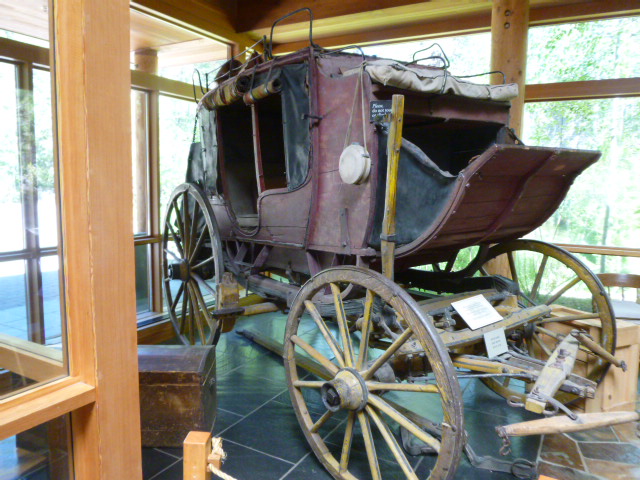

This is the real deal and probably the most famous stagecoach ever.
It carried several presidents and VIPs over the years.
It seats 6 - with considerable butt overlap.  

Lovely ride: several hours of dust pouring in the windows, crammed in like sardines, bouncing up and down on lousy roads, guy next to you hasn't showered recently, if ever.  No alternative though, if you weren't into riding horses and trains weren't available. 

Sunday, June 12, 2016

Birds of Prey

The World Center for Birds of Prey, sponsored by the Peregrine Fund, is located 5 miles south of Boise.  Founded in 1970, the Fund was established to save the Peregrine Falcon from extinction via a capture/breed/release program.  Their efforts were a success: they released 100s of falcons into the wild and they were removed from the endangered species list in 1999.  Now the Center is doing the same with condors.


Condors have the largest wingspan of any bird in the USA: 9.5'.
The specimen above is stuffed; the 2 below are part of the breeding program.


This fierce looking fellow is a harpy eagle, stuffed.


This little screech owl is being held by a volunteer.


More stuffed raptors.

The Center has assisted 65 countries with 100+ raptor species, has an extensive 
research library, numerous displays and several sculptures.

Falconry has been around for about 4000 years.  Initially, it was a means of capturing wild game for the dinner table, later, a status symbol hobby, currently, a bit of both.


Saturday, June 11, 2016

Idaho Capitol


The classic design is similar to many other state capitol buildings.
It appears seamless but the bump out wings were add-ons.


Did I ring the bell? 
Of course!


The multi-story columns are faux marble, boards covered with plaster.


These are real marble, well done, beautiful.


American Legion Boys State events were in progress in the senate and house chambers,
and several other rooms, as well.


George Washington, carved in wood.
I think the scale is off; George was 6' 2".


It appears lobbyists get locked in with this massive vault door.
Great idea!

Tuesday, June 7, 2016

Cathedral Gorge, NV

Our 2nd night on the road was spent at this state park, which is near Pioche, NV - which isn't near much of anything.  The Park has some great hiking trails through slot canyons but it was too darned hot for hiking when we arrived and we were only there one night.

I took a short hike the morning before we left, much cooler then, took a few pictures.


This old stone water tower was built by the CCC in the 1930s but was little used due to the high alkaline content of the water.


Might go back here another time,do some hiking. 

Tuesday, May 31, 2016

Timeless

He: "What time do you want to leave?"

She: "What are we gonna do when we get there?"

He: "What time do you want to leave?"

She: "Why do you want to leave so early?"

He: "What time do you want to leave?"

She: "What's the temperature gonna be there?"

He: "The high will be about 95.  What time do you want to leave?"

She: "It's only a 2-hour drive."

He: "No, it'll take 3 hours.  What time do you want to leave?"

She: "Okay, 3 hours."

He: "What time do you want to leave?"

She: "What time do you want to leave?"

He: "No later than 9 AM."

She: "Okay, 9.........ish."

He: I need a drink!

Friday, May 27, 2016

2 Long, 1 Short

If you're under age 60, you're probably clueless about the reference - although you've likely seen pictures of the related device.  And, you've likely heard the phrase, 'party line.'  We're talking telephones, here.  Old telephones.  Old systems.  In the early/mid 1900s, there were no phone numbers, just long and short ring combinations.  The phone ring combination on the farm in MN was 2 long, 1 short.

These were hand cranked phones in wood (yes, wood!) cabinets, attached to the wall, usually near the front door of the house.  To make a call, you lifted the earpiece and turned the little crank on the right side of the cabinet, which rang the the little bells located top front - on your phone and all phones on the party line.  Each home had it's own unique ring combination of longs and/or shorts.  You could call anyone on your party line, about 6 neighborhood homes, but that was it.  If you wanted to call someone not on your party line you had to ring the operator for assistance, 1 long.

If you heard someone talking when you lifted the earpiece, you were SOL, had to wait until the other call ended.  You had to keep lifting the earpiece every few minutes to see if the line was free.  Calls were supposed to be limited to 5 minutes but most people ignored that guideline.  If you thought the other call was running long, you'd lift the earpiece and toggle the hook a few times, causing a clicking sound that might inspire the other party line user to wrap it up.  Or not.  

Oft times, someone in a hurry would lift the earpiece and crank a call before realizing there was another call in progress.  Doing that was rude, scared the crap out of the people already on the line, pissed them off.  So, you'd quickly apologize and hang up.   

 Privacy there was not.  You could listen to any conversation on your party line, and eavesdropping (rubbernecking) was common.  A favorite family trick was to catch a sibling listening in, sneak up behind them and holler, "Gerry Delaney rubbernecking!"  Then, run like hell to avoid getting whacked.  Discretion was the better of valor, me being the youngest and smallest. 

Another, nastier, trick was to ring your own phone, then quickly hang up.  This caused all the other phones on the party line to ring.  Of course, I - never mischievous and always innocent of all charges - would never think of doing such a dastardly deed.  


Thursday, May 12, 2016

Fire Grenade

Ever heard that term, fire grenade?  Don't recall ever hearing it called that myself although we had one in our farm home in MN.  The name sounds militaristic, but it wasn't built for military use. Which is not to say it had no military application.


Fire Grenade
It was a household fire suppression device, about the size of a softball.

In case of fire, you were supposed to lift this thing out of its holder and throw it at the base of the fire.  To my knowledge, it was never used in our home - which is a good thing.  A good thing because there was no reason to use it, yes, but also because its effectiveness was iffy at best.  

"Holy crap, there's a fire in the kitchen!"  All pumped up on adrenaline, you grab the grenade and hurl it at the fire.  "Oops!"  You overshot the fire by a good 5', and it's the only grenade in the house.  Exit stage right.  Call your insurance agent.

"What kind of liquid did it contain?" you ask.  Excellent question!  Above, I hinted about a military application.  You better believe it!  The bulb was filled with carbon tetrachloride, which, when heated, can produce phosgene gas.  Phosgene gas was first used by the Germans in WW I, and caused an estimated 85,000 casualties.

Obviously, the word never got out about the dangerous contents of fire grenades.  Since I can remember having one in the house, it was still hanging there in the 1950s - and probably well beyond that.  Yeah, not having to use it was a good thing indeed.