Monday, August 8, 2016

Evergreen Air Musem

The Sopwith Camel, Snoopy's favorite plane, shot down the Red Baron in WW-1.


The Museum started with one huge building that contained the Spruce Goose.  Now there are 3 more buildings: a space museum, an indoor water park and an IMAX-format theater.

B-17 bomber, below.


The  huge Spruce Goose, below, dwarfs dozens of smaller aircraft.


Blackbird spy plane engine, above; the plane itself, below.

Which reminds me of the recent movie Bridge of Spies, starring Tom Hanks.  It's about recovering Gary Powers, the pilot of an earlier spy plane (the U-2) that was shot down over Russia.  Great flick!   


The Global Hawk unmanned surveillance aircraft, below, looks like a winged whale.


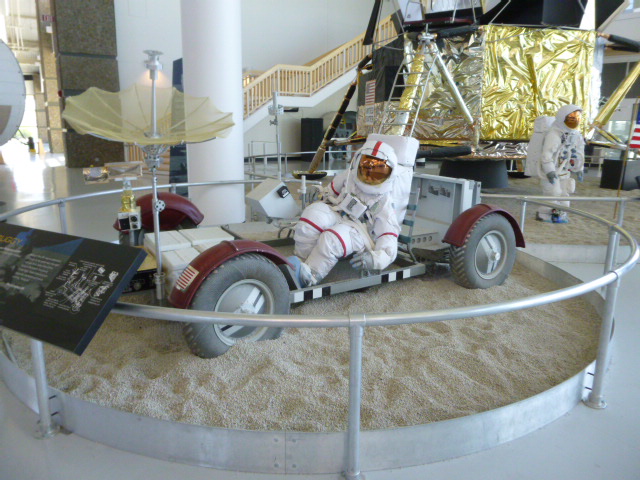
Moon stuff, below: unmanned research vehicle, lander and buggy.


The Museum is located in McMinnville, OR.

Monday, August 1, 2016

Big Red F

Dick and Jane.  Baby Sally.  Spot.  Those characters need no introduction to most folks my age.  For the benefit of younger blog readers: Dick and Jane books were written for grammar school kids who were just learning how to read.  They were simple texts that introduced new words and had illustrations showing the thing or activity associated with the word.  A typical page might have a picture of a boy running with these words below the picture: Dick.  See Dick.  See Dick run.  Challenging stuff!

Dick and Jane quickly became tiny specks in my rear view mirror.  A voracious reader from the get-go, I devoured the books in the grade school library.  My 5th grade teacher said I should write book reports.  The idea appealed to me: extra credit plus attractive milestone certificates for doing 50 reports, 100 reports, and so on.

My reports were written in cursive on a single sheet of wide-lined paper, with the name of the book and the author at the top.  Most of my story summaries were short and succinct: 3 sentences, main character, plot, ending, sign it, hand it in, read another book.

After several reports, my teacher said that I shouldn't tell the entire story. She said I should leave readers wondering about the ending, curious enough to want to read the book themselves.  Her advice was not well-received, I'm afraid.  It irritated me that my best efforts to retell the story in just a few words fell short of the mark.  My next report, in response to the teacher's advice, was the shortest I'd ever written.  It was one sentence long: "If you want to know what this book is about, read it."

You can probably guess what happened next.  The teacher returned my book report the next day, complete with a big red 'F' in the upper right corner.  It was my first F ever, also my last.

My ability to gracefully accept constructive criticism has improved in the interim, but honestly - not all that much.


Sunday, July 31, 2016

Pacific City, OR

Yesterday's outing was a 30 minute drive southbound along the coast to Pacific City.  We strolled the beach, visited an art gallery, had lunch at a brewpub.


One of very few places on the OR coast that allow vehicles on the beach, it can get quite crowded on nice summer weekend days.  This shot was taken at 11:30 AM when the crowd was still sparse. 


Surfers and paddle-boarders in wetsuits, Haystack Rock in background.

Those who know the north OR coast are now thinking, wrong!  Haystack Rock is in Cannon Beach.  They're right, it is.  And it's here, too.  There are 2 Haystack Rocks on the OR coast, and they're only 40 miles apart.  Go figure.


The 4 pilgrims.


Pelican brewpub.
We had clam chowder and the microbrew sampler: seven 3-ounce glasses.


Thursday, July 28, 2016

Netarts, OR


We've been lucky in scoring awesome campground sites this summer - although it's not all luck.  We invest a good deal of time and effort into researching and selecting the most desirable campgrounds well ahead of time, and when possible, making reservations and requesting specific sites.  Many private campgrounds won't reserve specific sites but will try to find one that fits one's needs or preferences.  Also, it helps to arrive early (late AM or early PM) to get the best selection of vacant sites.  We prefer short, 3-4 hour, drives anyway so that works well for us.


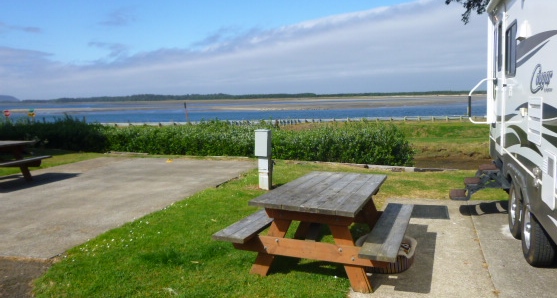
Our current site in Netarts is a case in point: full hookup with dynamite view of Netarts Bay and better privacy than most.  Looking out our huge rear window, we see a colony of harbor seals hanging out on a sand bar, pix above shows only a few; sometimes, we see well over 100.


Above pix shows the Cougar (upper right) parked beside the office/store.

Crabbing is good here, lots of little boats out in the Bay tending crab rings.  I used collapsible wire cages in my crabbing days but they use mostly rings here.  Depending on the type of bait you use, seals will try to steal it, wrecking the cages in the process.  Crabs aren't picky eaters, don't mind having chicken instead of fish.  Seals aren't into chicken, so that's what I used in my crab cages.

Below pix shows a fine catch of Dungeness crabs.  The crab boiler and fish/crab cleaning tables are directly in front of the office, right beside our RV.


Tuesday, July 26, 2016

Lake Quinault, WA


Lake Quinault Lodge, built in 1926, Adirondack style.


Lake and Sasquatch, aka yeti, aka Trish.


This 3-story rain gauge is front and center on the Lodge exterior.
The tan horizontal bar above the 12' mark indicates the amount
of rain in 2015: a mere 12.5 feet.


Yeti and I had lunch in the Roosevelt dining room (FDR ate here).
Keeping with the theme, Adirondack chairs grace the lawn.


World's largest Sitka Spruce tree, 1000+ years old, lives near the Lodge.


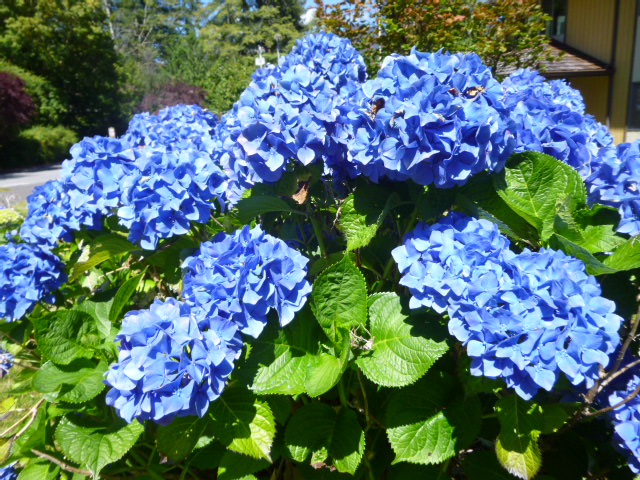
Hydrangeas abound in the area, obviously flourishing in the rain forest climate.

We stayed in a boutique RV park in Amanda Park on the Quinault River for 2 nights.  Only 5 RV sites and an 8-room motel; lovely place with friendly owner who sat and chatted with us awhile.  Pix below was taken at the RV park: fire ring, free firewood and chairs overlooking the River.


Friday, July 22, 2016

Sequim, WA


We're at Sequim Bay State Park for 5 days, after which we'll go around the Olympic Peninsula with a brief stop at Lake Quinault.  Sequim, the town, is allegedly in the 'rain shadow' of the Olympic Mts, boasts about 300 sunny days per year, and 16" of rain.  On the flip side of the Olympics, the Hoh Rain Forest - only 50 miles to the southwest - averages 13' per year.  That's not a typo: thirteen feet per year!

I used the term allegedly above because it's been raining for the past 12 hours and shows no signs of stopping.  16" per year, huh?  Color me skeptical.  No worries though, staying warm and dry in our little home on wheels.


There are several lavender farms around Sequim.

What does one do in Sequim?  Eat clam chowder, calamari, fish and chips; visit the Dungeness Spit with friends David and Elaine; bitch about the rain; Trish rides bike; Mike plays pickleball; do brats over the campfire; bitch about the rain some more.


The Dungeness Spit. above.

John Wayne liked this area, parked his yacht at the local marina, which now bears his name.


Sequim, pronounced 'skwim,' is the Indian word for skinny dipping.  "Hey Whispering Fawn, let's sneak out and go for a skwim tonight!"  Not really: it means hunting ground or good hunting.  Which reminds me of a related Indian word: vegetarian.  It means 'lousy hunter.'

Wednesday, July 20, 2016

Humptulips and Dosewallips

Odd place names intrigue me.  I speculate on the name origins, sometimes researching them online.  I've long wondered about these 2 doozies, which are a few miles apart on the Olympic Peninsula in WA state; we passed both places on our way to Sequim, WA, our current location.

The river and the small community of Humptulips get their names from a band of the Chehalis Native American tribe who lived in the area.  It means 'hard to pole' - referring to the poling of canoes along the Humptulips River.  Another source claims it means 'chilly region.'  I find both definitions highly suspect: obviously, it's fish stew made from humpback salmon and wild roots.


Dosewallips is the handle of a river and a state park. The name Dosewallips comes from a Twana Indian myth about a man named Dos-wail-opsh who was turned into a mountain at the river's source.  No alternative definitions popped up in my quick search, but it could very well mean 'a broad-beamed female square dancer.'